
Skydive Over Mount Maunganui
1 hour 30 minutes · Skydive Tauranga
from NZ$549 per person Check availability →
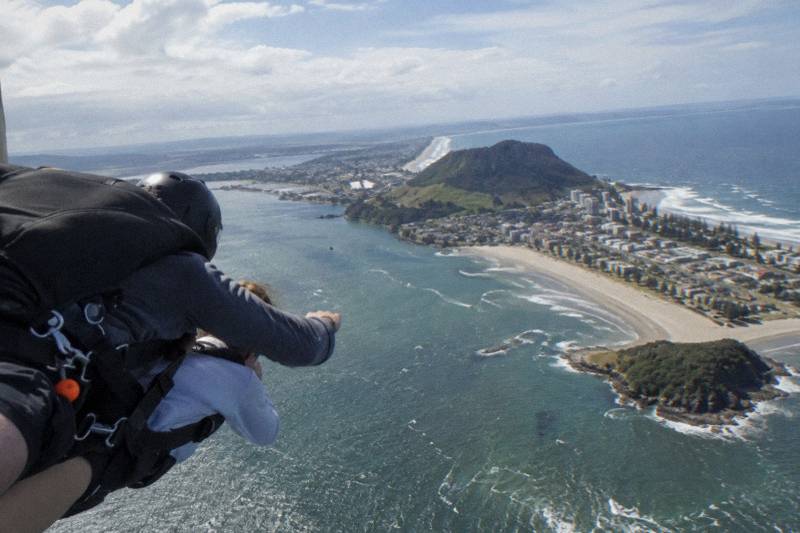
A tandem jump here leaves from Tauranga Airport, climbs over the harbour and Mauao, and puts about 40 seconds to a minute of freefall between you and the Bay of Plenty coast before you land back where you took off.
About 40 seconds of freefall after a 15-minute climb
About 1 minute of freefall after a 20-minute climb
The freefall seconds shown are the operator's own indication only and vary with weather, body shape and conditions on the day.
Three listings cover the tandem jumps run by Skydive Tauranga from Tauranga Airport: Skydive Over Mount Maunganui, the 15,000ft Tandem Skydive, and the Bay Of Plenty 15,000ft Skydive. All three meet at the airport in Mount Maunganui, take off and land there, list a minimum age of 7 and a weight range of 30 to 110 kg, and allow free cancellation up to 24 hours before for a full refund. Each runs about 1.5 hours door to door. The differences are mostly in framing and detail: Skydive Over Mount Maunganui carries 5.0 from 66 reviews on the listing and lists its inclusions most fully, while the other two are 15,000 ft products with plainer descriptions and no published review counts.
1 hour 30 minutes · Skydive Tauranga
from NZ$549 per person Check availability →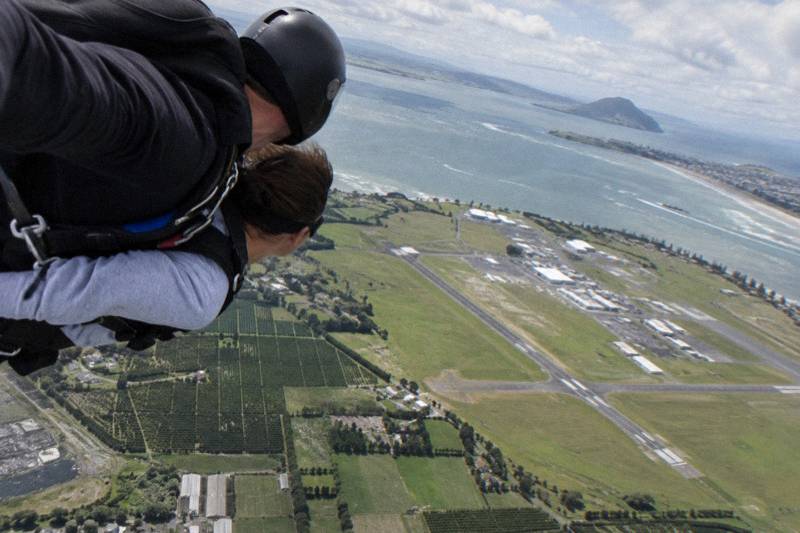
about 1.5 hours · Skydive Tauranga
Check live prices Check availability →Read the cards as what each listing says about itself. Inclusion lists differ: one lists the scenic flight, safety gear, drinks and photo options; another lists video and photos as available on the day; the third publishes no inclusions at all. Photos and video are paid extras whichever card you pick, with operator direct packages running from NZ$149 to NZ$349 depending on format. On price, the operator's own site quotes NZ$449 for 12,000 ft and NZ$549 for 15,000 ft, and those figures are for booking direct. What a listing charges can differ from the operator site, so treat the booking page as the price of record when you compare.
Arrive at Tauranga Airport, Mount Maunganui, at least 30 minutes before your scheduled takeoff. The operator's booking form prints the address as 2 Kittyhawk Way; company records give 2 Dakota Way for the same airport precinct, so "Tauranga Airport" is the reliable wayfinding answer. Either way you are steps from the runway. From check-in to landing, the whole experience takes between 1.5 and 2 hours, though a quiet day can move faster. There is a viewing area at the dropzone, so anyone travelling with you can watch the aircraft climb and the tandems come back down. The airport sits about 3 km northeast of Tauranga CBD, next to the harbour, roughly a 5 to 10 minute drive from the cruise ship dock if you are coming off a ship.
Check-in starts with paperwork: a waiver, plus a medical form asking you to list anything relevant, such as severe motion sickness, asthma, allergies, heart conditions, epilepsy or sinus congestion. The operator does not recommend jumping if you are pregnant, have been scuba diving within 24 hours, or suffer from a spinal or back injury. Be straight on the form. The operator reserves the right to withdraw anyone likely to endanger themselves or others, and can cancel a jump if they are concerned for anyone's safety. Weight comes up at this point too: under 110 kg you book freely, over 110 kg you should call ahead, and a small surcharge applies at heavier weights. Minimum weight is 30 kg, and the harness has to fit safely.
Then comes the gear. Everyone gets a hat, worn under NZ civil aviation rules, and goggles; the goggles are made to fit over glasses, though contacts are advised if you have them. A jumpsuit is provided and is optional when the weather is warm, so in summer you can jump in your own clothes. Gloves are handed out in the colder months. Your own footwear is the one thing to get right before you arrive: closed shoes that cannot fall off are mandatory, for safety reasons, and anything loose or open will not do. You are fitted into the tandem harness, checked, and introduced to your instructor. Under 18s need a consent letter from a parent or guardian, and children under 12 are asked to visit the dropzone first to be fitted and meet the staff.
The aircraft is a Cessna 182, and it takes two tandems at a time, so the load is small and the cabin intimate. The climb to altitude takes 15 to 20 minutes depending on whether you are jumping from 12,000 or 15,000 ft. That climb is itself a scenic flight: the harbour opens up beneath you, Mauao and the Mount Maunganui coast swing into view, and on a clear day the Kaimai Range marks the inland skyline. It is also when the nerves usually settle, because you can see exactly what you are about to fall into. Your instructor runs through the exit position and the harness checks on the way up, and the ride quietens down as everyone watches the altimeter.
The door opens and you step out attached to your tandem master. The numbers on the way down: about 40 seconds of freefall from 12,000 ft, about 1 minute from 15,000 ft, at speeds over 200 km/h. Treat those seconds as an indication only, since the operator notes freefall varies with weather conditions and body shape. There is no stomach-drop lurch, because you exit already moving with the aircraft and accelerate gradually to a stable speed. Screaming is fine and even helps with breathing in the windstream. Deployment is the tandem master's job, not yours, and CAA rule 105.11(c) requires the main canopy to open at not less than 5,000 ft, well above the ground work of the descent.
Once the canopy is open, the world goes quiet and slow. The operator's homepage says 3 to 4 minutes under canopy, its what-to-know page says 4 to 5, and one listing says 5, so expect a few minutes either way. Your instructor steers while you take in the harbour, Mauao's 232-metre dome, the long line of the coast and, out to sea, Matakana Island. It is gentle flying, nothing like freefall, and most people use it to let their pulse catch up. If you wear glasses, the goggles come off or stay on as suits. Landings are typically soft, with the instructor flaring the canopy and asking you to lift your legs for touchdown.
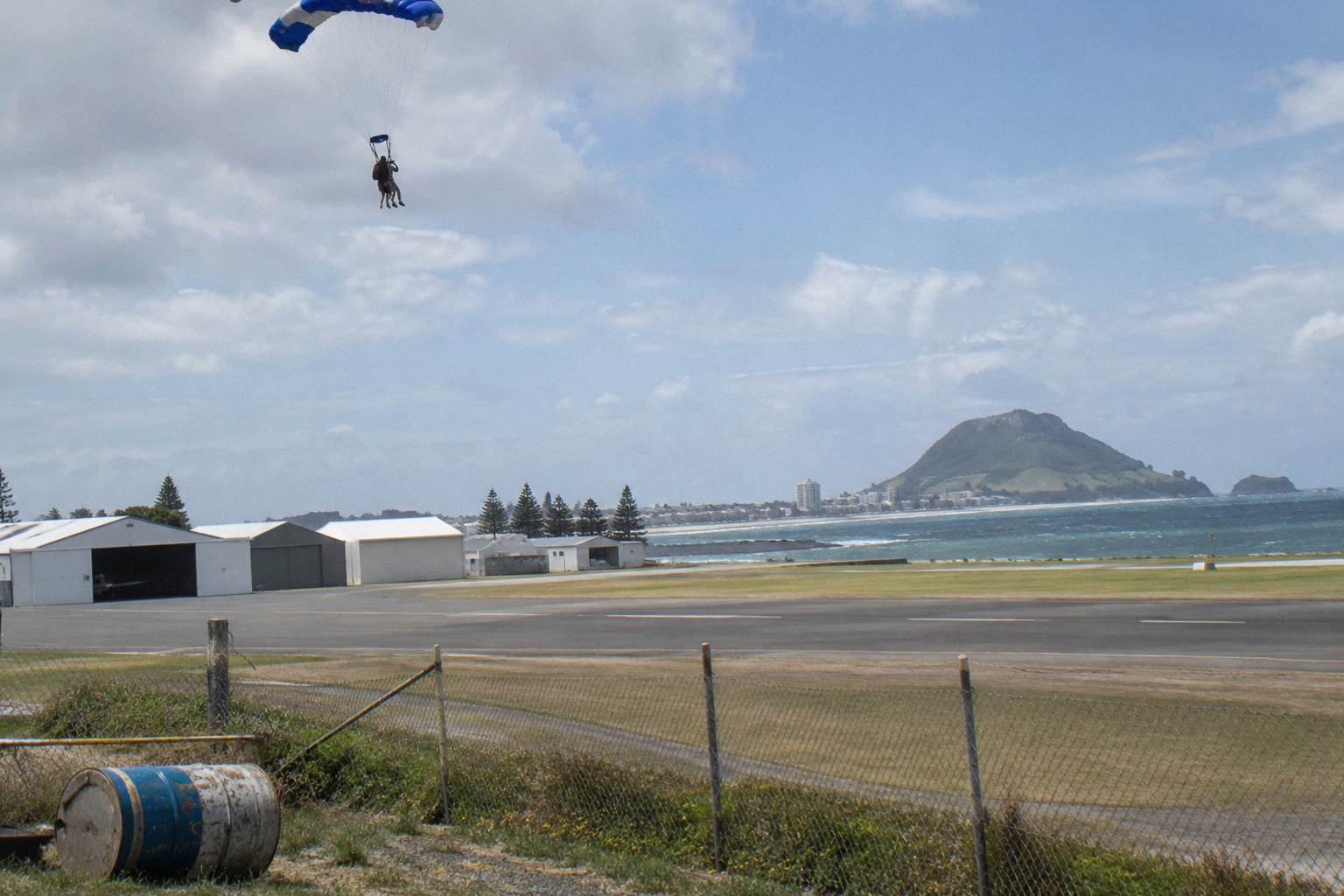
You land at the same airport spot you took off from, not on the beach. Mount Maunganui's sand is a view from above, nothing more, and the operator's landing area is deliberately kept small so the dropzone can co-exist with Air New Zealand's scheduled traffic next door. Spectators wait in the viewing area and watch you walk in. If you bought a camera package, delivery arrives by email as a Dropbox link, at the latest by the end of the day. One thing to know beforehand: under NZ civil aviation law, no tandem passenger is allowed to carry their own phone or camera during the jump, so all footage comes from the operator's mounted cameras.
Plan half a day around it and you will not be rushed. The whole experience runs 1.5 to 2 hours from arrival, with the first morning slot at 10am and the first afternoon slot at 12pm when there is no other booking, though you may be assigned earlier or later depending on availability. Weather is the main source of delay: if conditions look poor, the operator calls you on the day and works something out that fits your schedule. Airport traffic can also hold things up. If the weather turns on you entirely, the marketplace listings all allow free cancellation up to 24 hours before for a full refund, while direct operator bookings charge 50% for a cancellation the day before and full price on the day.
Skydive Tauranga sells two altitudes, and the choice is really about seconds. The 12,000 ft jump gives about 40 seconds of freefall after a 15-minute climb; the 15,000 ft jump stretches that to about 1 minute after a 20-minute climb. Both open the canopy for the same few minutes of riding, both take off and land at Tauranga Airport, and both are run by the same crew in the same Cessna 182. Freefall times are the operator's indication only and vary with weather and body shape, so the gap in practice may be a little more or less than the listed 20 seconds. The rest of this section lays out what each altitude includes and where the listings sit.
The 12,000 ft jump is the shorter of the two on paper and still delivers the full experience: a 15-minute scenic flight to altitude, about 40 seconds of freefall at over 200 km/h, then 3 to 4 minutes under canopy back to the airport. On the operator's own site it is quoted at NZ$449 direct. Among the listings, it appears as the freefall option within Skydive Over Mount Maunganui, which lets you choose between 30-45 seconds or 1 minute of freefall depending on the option selected, so a 12,000 ft style jump is reachable through that card as well as by booking direct. For a first jump, 40 seconds is a long time in real life, longer than most people expect once the door opens. The Tauranga cards themselves are 15,000 ft products, so check the option selected on the booking page before you pay.
The 15,000 ft jump is what the Tauranga listings sell: a 20-minute climb, about 1 minute of freefall, 3 to 4 minutes under canopy, roughly 1.5 hours all up. The operator's own site quotes NZ$549 direct. Three cards carry this altitude: Skydive Over Mount Maunganui, the 15,000ft Tandem Skydive, and the Bay Of Plenty 15,000ft Skydive, all meeting at Tauranga Airport with the same age and weight rules and the same 24-hour free cancellation terms. A minute of freefall does not sound like much more than 40 seconds, but at that speed an extra third again of fall time is a genuinely different ride, and the longer climb buys five more minutes of harbour and coastline on the way up.
Money, seconds and view, in that order of usefulness. The gap between the operator's direct prices is NZ$100, from NZ$449 at 12,000 ft to NZ$549 at 15,000 ft, and the listing price can differ from both, so check the booking page before deciding on budget. The real difference on the way down is freefall time: about 40 seconds versus about 1 minute, both indication only. On the way up, the 15,000 ft jump simply spends five more minutes climbing, which means five more minutes of scenery from the aircraft window. Neither altitude is safer than the other; the same gear, the same instructor role and the same minimum deployment altitude of 5,000 ft apply to both.
If it is still not obvious, the short chooser below asks three questions: what your budget ceiling is, whether the extra freefall seconds matter to you, and whether you want photos or video on the day. Answer those and it narrows the roster to the altitude and the card that fit. It will not book anything for you, and it will not tell you what the weather is doing a week out, but it removes the listings that were never in the running. The final click happens on the listing.
This is a starting shortlist of rated options, not the full list. Tap an answer to rebuild it around you.
about 2 hours Taupo Tandem Skydiving Free cancellation
See live price ★ 5.0 457 reviews
Check availability →Taupo Tandem Skydiving Free cancellation
from NZ$329 ★ 4.9 376 reviews
Check availability →about 1.5 hours Skydive Tauranga Free cancellation
See live price ★ 5.0 322 reviews
Check availability →about 1.5 hours Skydive Tauranga Free cancellation
See live price ★ 5.0 316 reviews
Check availability →1 hour 30 minutes Skydive Tauranga Free cancellation
from NZ$549 ★ 5.0 66 reviews
Check availability →Heli Adventure Flights Ltd Free cancellation
from NZ$719
Check availability →2 hours Skydive Tauranga Free cancellation
from NZ$1,998
Check availability →30 minutes Skydive Tauranga Free cancellation
from NZ$698
Check availability →1 hour 30 minutes Skydive Tauranga Free cancellation
from NZ$1,398
Check availability →2 hours 30 minutes Adventure Helicopters Free cancellation
See live price
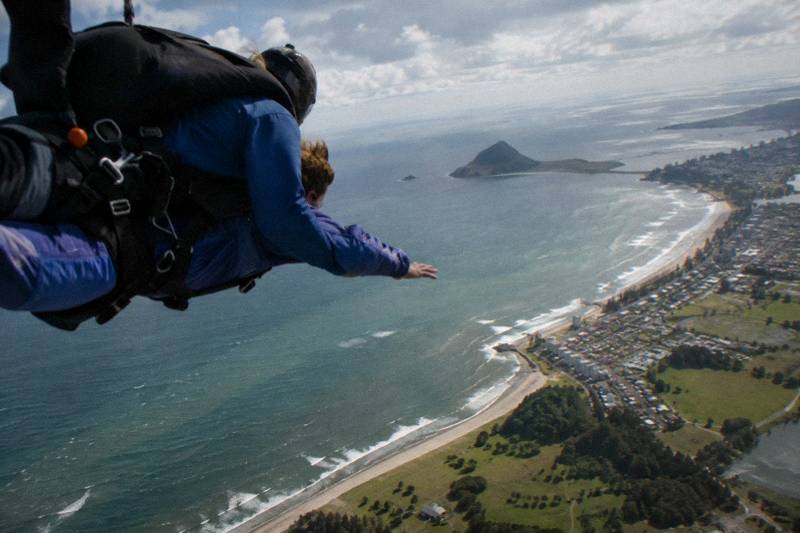
Check availability →The Bay of Plenty earns its name from the air. On the climb you are looking down on a working harbour, a city threaded around its edges, and a coast that runs unbroken in both directions. Freefall compresses all of it into a rushing minute, but the few minutes under canopy are when the geography becomes readable: the volcanic dome of Mauao, the sand split of the isthmus, the long green bar of Matakana Island, and inland, on clear days, the Kaimai Range. None of it is guaranteed on any given jump. What follows is what the view takes in when conditions cooperate, listed as landmarks rather than promises.

Mauao, the dormant volcanic cone at the harbour entrance, rises 232 metres above sea level and anchors every view from this dropzone. From altitude it reads as a green dome ringed by water on three sides, with the walking track a faint line around its base. Under canopy you often circle close enough to pick out the summit. It is the landmark your brain locks onto in freefall, the fixed point while everything else streams past.

The beach and isthmus between Mauao and the mainland are what postcards from Mount Maunganui are made of: white sand on the ocean side, calm harbour water on the other. From the aircraft and under canopy you see the whole sand spit in one frame. Note that it is a view only. Tandems land at the airport, never on the beach, so if you pictured touching down on sand, adjust the picture: you land on grass beside the runway.

Matakana Island stretches 20 kilometres along the coast, a slim barrier of dune and pine forest separating the ocean from Tauranga Harbour. From jump altitude it looks like a pencil line drawn across the water, with the harbour channel winding behind it. Its length is the surprise: it runs on well past the horizon in most conditions, and it gives the seaward view from the dropzone its sense of scale.

Tauranga Harbour is the water the airport sits beside, roughly 3 km northeast of the CBD. It is a shallow, many-armed tidal harbour, and from a few thousand feet its channels and mudflats spread out in patterns that shift with the tide. The climb out usually tracks across or along it, so you get the harbour twice: once on the way up, once hanging under canopy, quieter and slower, with time to trace the shipping channel toward the port.
The Kaimai Range forms the inland skyline on clear days, its highest point Mount Te Aroha at 953 metres. From the Bay of Plenty side the range reads as a long blue-grey wall separating coastal lowland from the Waikato behind it. How much of it you see depends entirely on the day: haze, cloud or a low ceiling can hide it completely. On a clear winter morning, it is the most dramatic part of the view after the coast itself.
How much of this you actually see comes down to three things. Weather on the day is the biggest: cloud ceilings, haze and wind direction reshape the view more than any choice you make. Altitude matters next, since the 15,000 ft climb simply spends longer up in the scenery. And which way you face, in the aircraft and under canopy, decides whether your minute of freefall is spent over the harbour or out to sea. None of it can be promised in advance, which is also why the operator calls on the day if the forecast looks poor.
Every listing carries its own price on the booking page, and that figure is the one to check before committing. No listing price is printed here, because marketplace rates can differ from what the operator charges directly. For reference, the operator's own site lists a 12,000 ft jump at NZ$449 and a 15,000 ft jump at NZ$549. Those are operator figures, not a promise of what a listing will show. Treat them as a baseline when comparing the two altitudes or weighing a Tauranga jump against a Taupo one. Photos and video sit outside those numbers entirely, as paid extras on the day. The gap between 12,000 and 15,000 ft comes down to longer freefall and a longer climb, roughly 40 seconds against about a minute, with a 15 to 20 minute scenic flight to altitude.
Camera packages are extra, and the choice matters because passengers cannot bring their own phone or camera on the jump. Under New Zealand civil aviation rules, no tandem passenger may carry one. The operator's options: a wrist camera on the instructor's arm, at NZ$149 for photos only or NZ$159 for video only, or NZ$189 for both. A 360 camera package costs NZ$229, with the instructor filming the whole experience and the best angles edited into a video of roughly three to four minutes. The outside camera flyer option, NZ$349, puts another skydiver in the air with you with a camera mounted to their helmet, and it must be prebooked rather than arranged on the day. Finished files arrive by email through a Dropbox link, at the latest by the end of the day.
| Camera Option | Filmed By | What You Get | Booking |
|---|---|---|---|
| Photos | Wrist camera on the instructor | Photos | On the day |
| Video | Wrist camera on the instructor | Video | On the day |
| Photos and video | Wrist camera on the instructor | Photos and video | On the day |
| 360 camera | The instructor | Edited video, roughly 3 to 4 minutes | On the day |
| Outside camera flyer | Another skydiver, helmet camera | Footage from beside you in the air | Prebook |
What a listing includes varies, so read the inclusions on each booking page before choosing. The Skydive Over Mount Maunganui listing covers the 20 to 25 minute scenic flight to altitude, the canopy ride, a few minutes of freefall depending on the option, all safety equipment such as jumpsuit, frap hat, goggles, gloves and harness, plus coffee, tea or water, free WiFi, and photo and video options arranged on the day. One of the 15,000 ft listings lists GST and notes video and photos are available on the day. The Taupo listings have their own lists, including hotel pickup and drop-off on the 12,000 ft product and a complimentary buff headband on the up-to-15,000 ft product. Where a listing shows no inclusions, assume nothing and confirm on the booking page.
Booking through the operator's own site works differently from a marketplace listing. The operator takes a card to reserve your slot but does not charge the jump at that point; you pay on the day unless a third party has already paid. Every marketplace listing here allows free cancellation up to 24 hours before, for a full refund. Direct with the operator, the rule is stricter: free before the day before, 50% of the price if you cancel the day before, and full price if you cancel on the day. No-shows are charged. Gift vouchers are valid for a year, are non refundable, but can be transferred or resold. If flexibility matters, the 24 hour cancellation window on a listing is the safer route.
Tandem skydiving has physical limits, and Tauranga's operator states theirs plainly. Age, weight and health each carry rules, some set by the operator rather than by law. There is also a general reservation: the operator reserves the right to withdraw any person who, in their opinion, is likely to endanger themselves or others, and to cancel a skydive if they become concerned for anyone's safety. That judgement sits with the staff on the day, after they have seen you, your harness fit and the conditions. The panels below set out the age rule, the weight bands and the health conditions worth declaring before you arrive. Reading them first avoids the disappointment of a refused jump at the dropzone.
| Rule | What The Operator Says |
|---|---|
| Minimum age | 7 years, set by the operator; under 18 needs a parent or guardian consent letter |
| Minimum weight | 30 kg, mainly about fitting the harness |
| Weight, book freely | Under 110 kg |
| Weight, call first | Over 110 kg: call the operator, a small surcharge applies |
| Health | Not recommended if pregnant, within 24 hours of scuba diving, or with a spinal or back injury; declare other conditions |
The minimum age is 7, and that is the operator's own rule rather than a legal one. New Zealand law sets no age limit for skydiving; the operator has chosen 7 because they want the jump to be the child's own decision. A young jumper also has to meet the 30 kg minimum weight and fit safely into the harness. Children under 12 are asked to visit the dropzone first, to meet the staff, see the setup and be fitted in a harness before any booking is locked in. Anyone under 18 needs a letter of consent from a parent or guardian. At the other end there is no maximum age, though fitness and harness fit are assessed on the day for every jumper.
The minimum weight is 30 kg, and the operator frames it as being less about a number than about fitting safely into the harness. Below 110 kg, book freely with no need to ask first. Above 110 kg, call ahead: the operator will talk it through based on weight and size, and a small surcharge applies, paid to the tandem instructor for the added strain. No dollar figure for that surcharge is published. The operator's own pages disagree on the ceiling: the booking form states a maximum of 110 kg, while another page gives 115 kg including shoes and clothes. Anyone near either number should phone before booking. No BMI rule is published.
The operator's waiver does not recommend a skydive if you are pregnant, have been scuba diving within 24 hours, or suffer a spinal or back injury. Beyond those, the waiver asks you to declare conditions the staff need to know about to include you safely: severe motion sickness, asthma, allergies, heart conditions, epilepsy, or nasal and sinus congestion. Declaring something does not automatically disqualify you; many managed conditions are compatible with a tandem jump, and well controlled cases are often cleared with physician input. There is no published BMI rule. The final call rests with the operator, who can withdraw anyone likely to endanger themselves or others, or cancel the jump over safety concerns. Full disclosure before arrival beats a refusal at the dropzone.
If any of this leaves you unsure, call the operator before booking rather than after. The staff handle these questions routinely, and a two minute conversation about weight near the limit, a child's harness fit or a heart condition is cheaper than a forfeited jump. One detail worth knowing: glasses are fine. The operator advises contact lenses if you can wear them, but keeps special goggles that fit over prescription frames, so poor eyesight is no barrier. Contacts are also allowed, with a word to the instructor so the goggles can secure them. Whatever your situation, sort it out in advance, in writing if possible, and check the listing's 24 hour cancellation window as a fallback if plans change.
Every Tauranga tandem listing meets at Tauranga Airport, Mount Maunganui. The listings and the company register give 2 Dakota Way, Mount Maunganui 3116, while the operator's own booking form prints 2 Kittyhawk Way, so the reliable anchors are the airport itself and the pin on the booking page. The airport sits in the Mount Maunganui suburb next to Tauranga Harbour, roughly 3 km northeast of Tauranga CBD. Both takeoff and landing happen here, on the airport grounds; the plane boards, climbs, and returns to the same spot, where a spectator viewing area sits beside the landing zone. Mount Maunganui beach is a view from altitude, not a landing site.
Showing all nine mapped points around Tauranga, grouped into three sets. Pick a set to narrow the list and dim the other pins.
The operator's FAQ puts the airport a 5 to 10 minute drive from the cruise ship dock, and the terminal at Salisbury Wharf in Mount Maunganui sits about 5 to 6 km away, which matters for cruise passengers on a tight turnaround. Driving from Auckland covers 204 km and takes about 2 hours 30 to 40 minutes. Hamilton is closer at roughly 105 km, Rotorua about 57 km, and Taupo around 143 km. Flying in is also practical: Air New Zealand operates direct flights into Tauranga Airport from Auckland, Wellington and Christchurch, which puts the dropzone effectively at your arrival gate. Whatever the route, plan to arrive at least 30 minutes before the scheduled takeoff, as the operator requests.
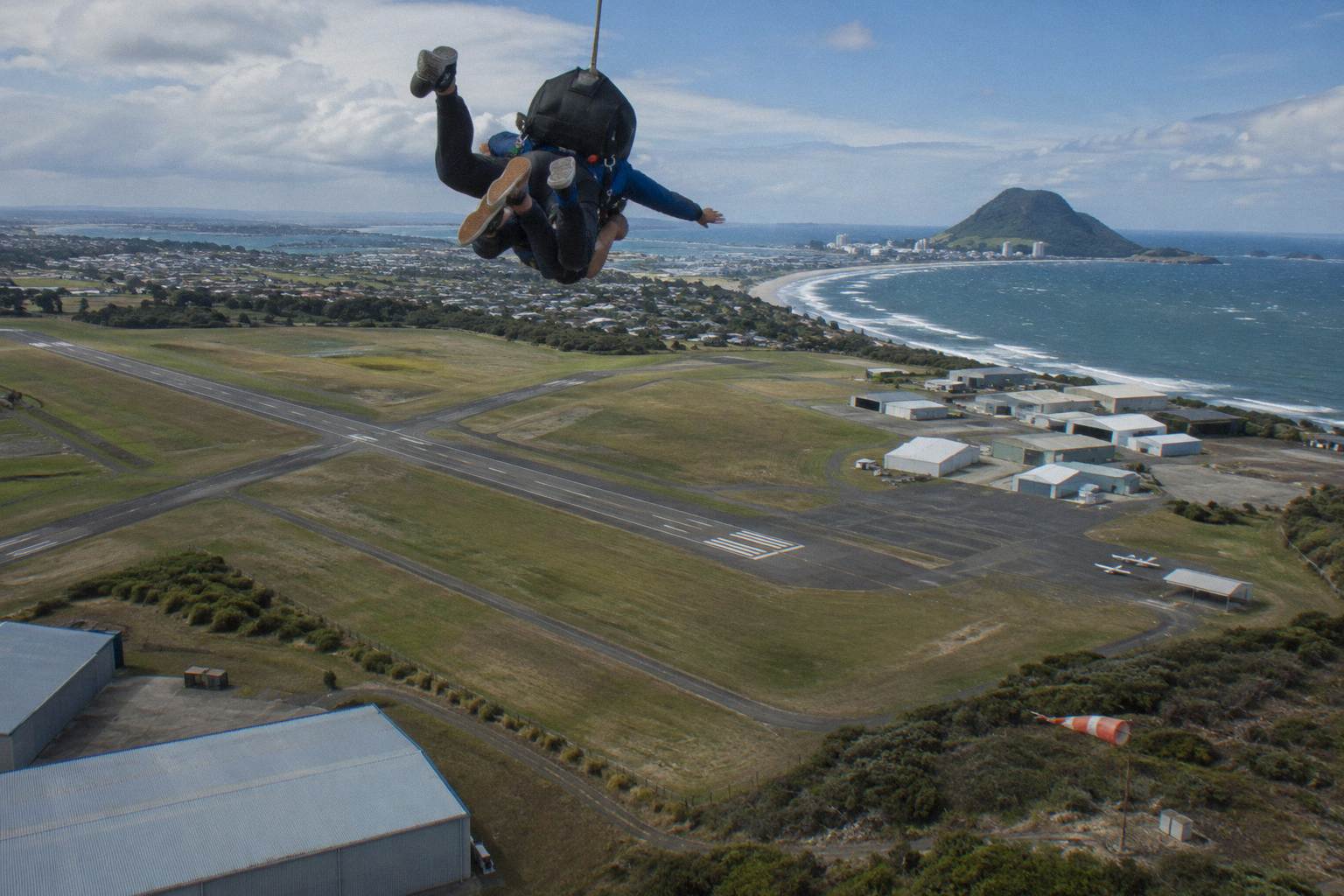
Tauranga Airport is a working regional field, and the skydive operation shares it with scheduled Air New Zealand services. That shapes the jump in small ways. The landing area is small, and the operator notes there are plenty of rules so the dropzone can co-exist with Air New Zealand, which are not friendly to solo jumpers. Spectators get their own viewing area, and the plane takes off and lands in the same place, so friends and family can watch the whole cycle from one spot. The shared airspace and airport traffic also explain a quirk the FAQ flags openly: sometimes the operation runs a little late due to weather or traffic on the airport. Build slack into your day rather than a tight schedule.
Tauranga averages around 2,400 hours of sunshine a year, but sunshine is not a schedule. The operator publishes no season, no opening days and no weekly hours on its own site, so the only fixed reference points are booking slots: the first morning jump is at 10 am, the first afternoon jump at 12 pm when there is no earlier booking, and you may be assigned a slot earlier or later depending on availability. Weather decides the rest. High winds, low cloud or rain hold jumps anywhere, and conditions on the day override any calendar. The practical approach is to check the listing calendar for open dates, book a slot, and keep a spare window in your trip in case the sky changes its mind.
Slots are simple at this dropzone. The first jump of the morning goes up at 10 am; the first of the afternoon at 12 pm, when no earlier booking occupies it. Depending on availability, you might be given a time earlier or later than those anchors, so treat them as the shape of the day rather than a promise. On a quiet day the whole visit can run quicker, and the operator suggests allowing about 1.5 hours on site, with arrival at least 30 minutes before your scheduled takeoff. The aircraft is a Cessna 182 carrying two tandems at a time, which is why groups may be split across loads. Booking a morning slot gives more room for a weather delay or a later reload.
Weather, not the calendar, is the real gatekeeper. The operator says that if the weather does not look good, they will phone you on the day and work something out with you to fit your schedule. What they do not publish is a weather refund rule, so the terms of a weather cancellation are left open on their own pages. The marketplace listings are clearer: free cancellation up to 24 hours before, with a full refund, and that window applies to every one of them. Wind strength, gusts and low cloud are the usual holds, and those calls belong to the operator on the day. Booking with the 24 hour window intact leaves a clean exit if the forecast turns.
There is no published season here, and it is better to say so plainly than guess. The operator's site lists no opening months, no days of the week and no hours beyond the slot times. What the site does say is practical: in colder months a jumpsuit and gloves are supplied, and in warmer months you are welcome to jump in your own clothes. A community directory, which is not the operator's site, claims the dropzone runs seven days a week weather permitting, with July and August weekends only, but that does not appear anywhere the operator controls. Treat it as unconfirmed. The listing calendar is the only authoritative view of which dates actually have slots, so check it for the week you plan to visit.
One piece of advice holds whatever the month: leave slack. A single arrival day with a booked jump and a flight out the next morning is a fragile plan, because a wind hold or a low ceiling can push everything. A flexible day or two in Tauranga, with the jump booked early in the stay, gives room to reload if the sky refuses to cooperate. Free cancellation up to 24 hours before applies to every listing, so holding a slot costs little if plans shift. Morning slots help too, since a delay still leaves afternoon room. Tauranga's sunshine record is on your side, but the forecast, not the average, decides your jump day.
Three listings cover tandem jumps from Tauranga Airport: 15,000ft Tandem Skydive, Bay Of Plenty 15,000ft Skydive and Skydive Over Mount Maunganui, all meeting at Tauranga Airport, Mount Maunganui. Skydive Over Mount Maunganui, rated 5.0 from 66 reviews, includes the 20 to 25-minute scenic flight to altitude, 30 to 45 seconds or 1 minute of freefall depending on the option chosen, a 5-minute flight under canopy, free WiFi, all safety equipment (jumpsuit, frap hat, goggles, gloves and harness), coffee, tea or water, and photo and video options. The 15,000ft Tandem Skydive listing includes GST and lists video and photos as available on the day. The Bay Of Plenty listing does not spell out inclusions. Photos and video are paid extras on every jump. All three allow free cancellation up to 24 hours before for a full refund. The comparison table below lines them up side by side.
| Listing | What The Listing Includes | Cancellation |
|---|---|---|
| Skydive Over Mount Maunganui | 20 to 25-minute scenic flight; 5-minute flight under canopy; 30-45 seconds or 1 minute of freefall (depending on option selected); Free WiFi; All safety equipment including jumpsuit, frap hat, goggles, gloves, and harness; Coffee, tea, or water; Photo and video options | Free cancellation up to 24 hours before |
| 15,000ft Tandem Skydive | GST (Goods and Services Tax); Video and Photos (available on the day) | Free cancellation up to 24 hours before |
| Bay Of Plenty 15,000ft Skydive | Not listed on the page; check the listing | Free cancellation up to 24 hours before |
The operator keeps it simple: bring a smile and comfy clothes. Wear something weather-appropriate, because the jumpsuit is optional when it is warm, and many people jump in their own clothes in summer. In colder months a jumpsuit and gloves are supplied. A hat and goggles are provided on every jump, and the goggles fit over glasses, so contact lenses are a choice rather than a requirement. Footwear is the one hard rule: closed shoes that cannot fall off during freefall are mandatory, so leave the jandals and loose slides behind. Winter gloves are worth asking for on chilly mornings at the airfield. One more rule matters: under New Zealand civil aviation rules, no tandem passenger is allowed to carry their own phone or camera during the jump. Cameras belong on the instructor's wrist, not in your hand.
Arrive at least 30 minutes before your scheduled takeoff. The whole experience takes between 1.5 and 2 hours, though on a quiet day it can be quicker. Spectators are not left standing on the fence line: there is a viewing area, and the aircraft takes off and lands in the same place, so friends and family see the exit and the landing. The listing also includes free WiFi along with coffee, tea or water while you wait. Weather and airport traffic can cause small delays, so build a little slack into the rest of your day.
Not everyone wants to leave an aircraft at 15,000 ft, and the scenic flight listings from Tauranga are the seat-belted alternative. Three fixed-wing flights run from Tauranga Airport, and one helicopter tour, the Cathedral Cove coastal trip, departs from the same base. Lengths range from a 30-minute Mount Maunganui scenic flight to a two-and-a-half-hour Cathedral Cove helicopter tour that includes about 1.5 hours of flying, with a 1.5-hour Coromandel and Cathedral Cove flight and a two-hour Ruapehu flight in between. There is also a Taupo option that pairs a helicopter flight with a 15,000 ft tandem skydive. All of these carry free cancellation up to 24 hours before, with a full refund. Every booking happens on the listing page.
Four scenic flights now cover the range. The shortest is the 30-Minute Mount Scenic Flight, a fixed-wing loop around Mauao and the Bay of Plenty beaches from Tauranga Airport, run by Skydive Tauranga. The Coromandel and Cathedral Cove Scenic Flight stretches to 1.5 hours in the same fixed-wing style, and the Mount Ruapehu Scenic Flight commits a full 2 hours to the volcano round trip. The only Tauranga helicopter product is the Cathedral Cove Scenic Coastal Helicopter Tour, a 2.5-hour outing with about 1.5 hours of flying, operated by Adventure Helicopters. Taupo adds a helicopter option too, pairing a scenic flight with a 15,000 ft tandem skydive through Heli Adventure Flights Ltd. From a half-hour loop to a half-day coastal tour, the local view from above starts close to the airport.
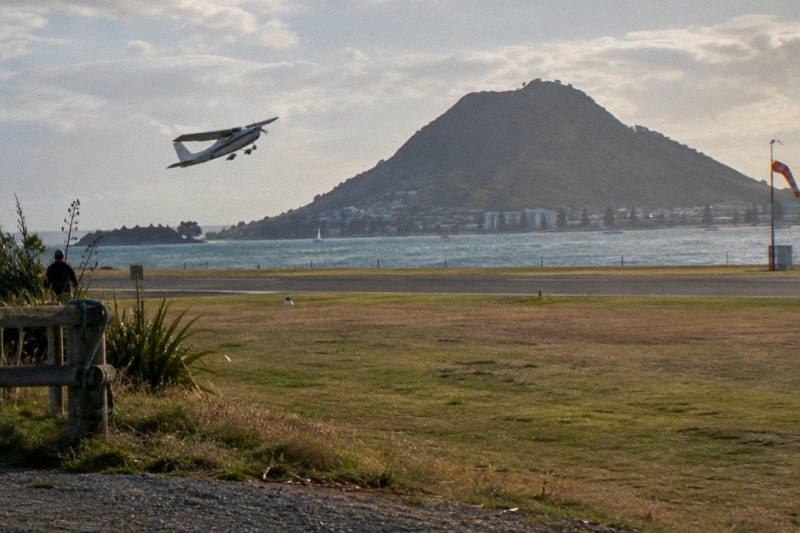
30 minutes · Skydive Tauranga
from NZ$698 Every price here is per person unless the individual listing says otherwise. Check availability →The longer flights trade a short hop for real distance. The Two-Hour Ruapehu Scenic Flight leaves Tauranga Airport and crosses the harbour and the kiwifruit orchards of Te Puke, over the Rotorua lakes and towards Lake Taupo before climbing towards Mount Ruapehu, taking in the Alpine Plateau, the Tongariro Crossing and Mount Ngauruhoe, with views of Mauao thrown in. The 1.5-hour Coromandel And Cathedral Cove Flight heads north instead, with return flights and a guide included. The 2.5-Hour Cathedral Cove Heli is the longest of the six, pairing the helicopter ride with time at the Cove itself.
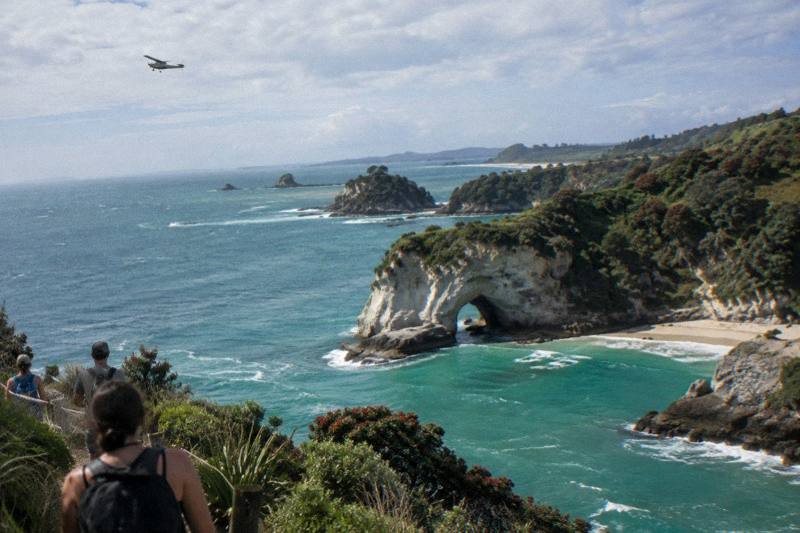
1 hour 30 minutes · Skydive Tauranga
from NZ$1,398 Every price here is per person unless the individual listing says otherwise. Check availability →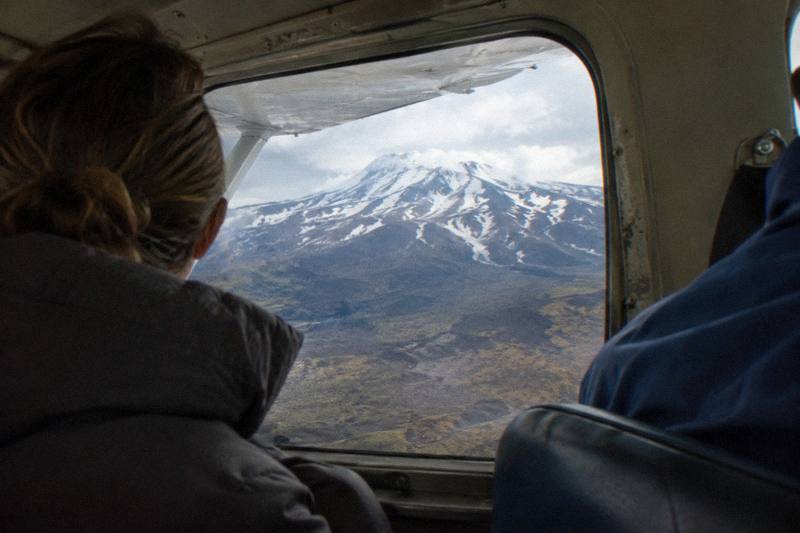
2 hours · Skydive Tauranga
from NZ$1,998 Every price here is per person unless the individual listing says otherwise. Check availability →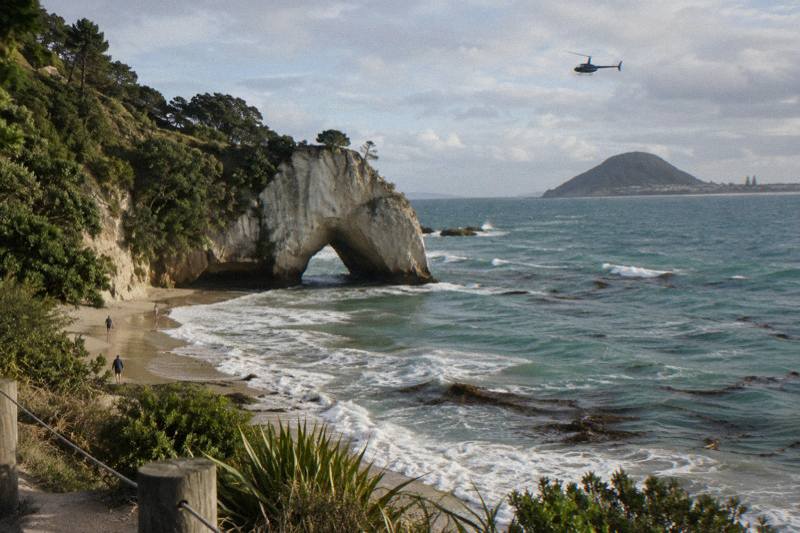
2 hours 30 minutes · Adventure Helicopters
Check live prices Check availability →A jump and a flight answer different questions. The skydive gives 30 to 45 seconds or a minute of freefall over the Bay of Plenty coastline, plus the scenic climb to altitude, and lands back at Tauranga Airport. A scenic flight keeps you in the cabin for 30 minutes to 2.5 hours and covers far more country, from Mauao to Ruapehu or Cathedral Cove. Mixed groups can split: one person books the 15,000 ft jump while the others take the 30-minute flight, and everyone watches the landing from the same viewing area. Travellers with more time and a taste for both can look at the Taupo helicopter-plus-skydive listing further down.
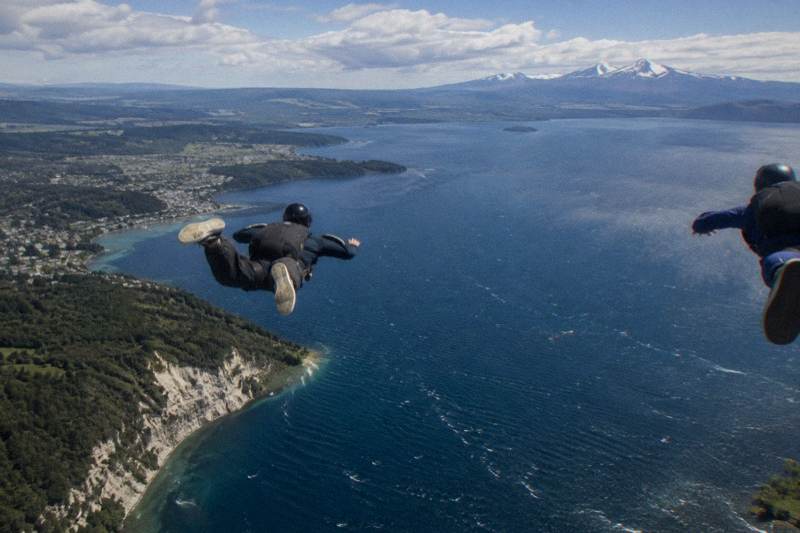
Tauranga is not the only dropzone reachable on a Bay of Plenty holiday. Three listings cover skydives over Lake Taupo, New Zealand's largest lake, and they bring serious review weight: Lake Taupo 12,000ft Skydive holds 5.0 from 457 reviews, and Up To 15,000ft Over Lake Taupo holds 4.9 from 376. A third listing, Helicopter Plus 15,000ft Skydive, combines a scenic helicopter flight with the jump. The Taupo listings do not state a Tauranga meeting point, so check the booking page for where each one starts and how you get there. All three allow free cancellation up to 24 hours before for a full refund.
about 2 hours · Taupo Tandem Skydiving
Check live prices Check availability →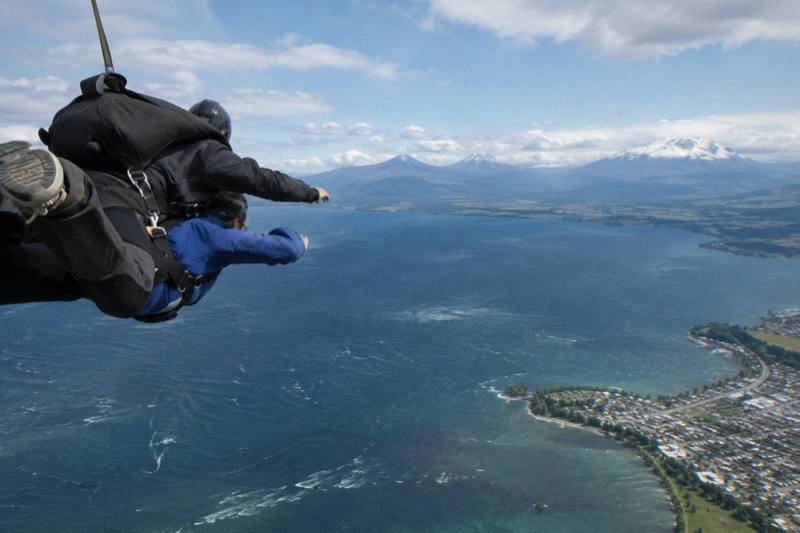
Heli Adventure Flights Ltd
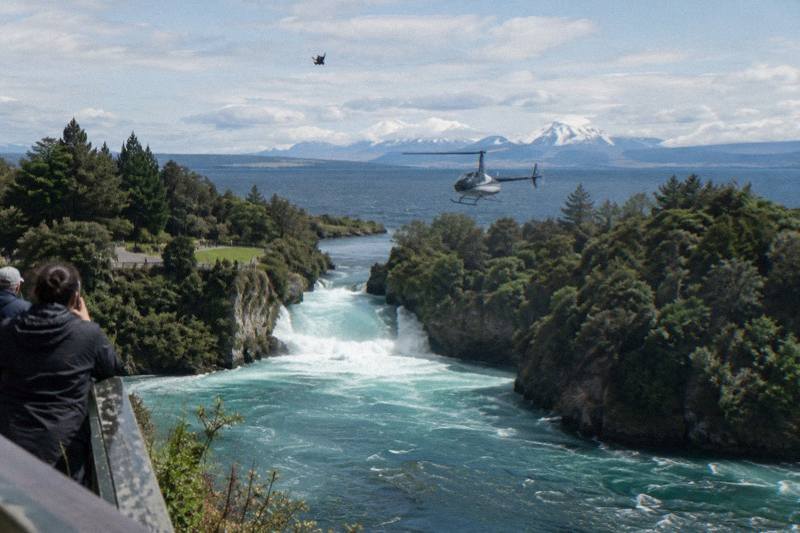
from NZ$719 per person Check availability →The Taupo listings bundle more than the jump itself. The 12,000 ft listing includes a professional guide, harness, jumpsuit and goggles, a free buff you keep, hotel pickup and drop-off, and all taxes and fees. The Up To 15,000ft listing adds free pickup and drop-off from your Taupo accommodation, free Rotorua pickup for groups of 6 or more, a safety briefing, an experienced tandem master, a complimentary buff headband, a certificate of completion, and photo and video packages from NZ$139 that can be added on the day. The Helicopter Plus 15,000ft Skydive listing includes a scenic helicopter flight over Lake Taupo with views of Huka Falls, Craters of the Moon Geothermal Park, the Taupo boat harbour and the Maori Rock Carvings, plus views of Mount Ruapehu, Mount Ngauruhoe and the lake, which spans 616 km².
| Listing | Exit Height | Rating | Where You Start |
|---|---|---|---|
| Skydive Over Mount Maunganui | 15,000 ft | 5.0 from 66 reviews | Tauranga Airport, Mount Maunganui |
| 15,000ft Tandem Skydive | 15,000 ft | No rating on the listing | Tauranga Airport, Mount Maunganui |
| Lake Taupo 12,000ft Skydive | 12,000 ft | 5.0 from 457 reviews | Hotel pickup and drop-off on the listing |
| Up To 15,000ft Over Lake Taupo | 12,000 or 15,000 ft | 4.9 from 376 reviews | Free pickup from Taupo accommodation, options on the listing |
| Helicopter Plus 15,000ft Skydive | 15,000 ft | No rating on the listing | Heli Adventure Flights base or local accommodation transport |
Both dropzones reach 15,000 ft, so the choice comes down to scenery and logistics. Tauranga jumps take off and land at Tauranga Airport, a short drive from Mount Maunganui, with the harbour, Mauao and the coast below. Taupo jumps go over the country's largest lake, with volcano views on the climb, and both Taupo listings include accommodation pickup, which the Tauranga listings do not. Reviews run 5.0 from 457 and 4.9 from 376 for Taupo against 5.0 from 66 for the Mount Maunganui jump. If you are staying in Mount Maunganui and want the shortest trip to the dropzone, Tauranga wins on convenience. The table below carries the full numbers.
“Absolutely incredible!! The team made me feel so safe.”
Hannah, review of Skydive Over Mount Maunganui
“This was the best experience. I recommend for anyone and it is all worth your money”
Robyn, review of Skydive Over Mount Maunganui
“Everything was well organized and fun. People were very friendly and answered any questions we had. Freefalling was great and didn't feel any jerk when the parachute opened.”
Zena H., review of Bay Of Plenty 15,000ft Skydive
“It is awesome and beautiful view. You must do it when you are visiting Tauranga. Fantastic experience!!!!”
Susan W., review of Bay Of Plenty 15,000ft Skydive
“It's a great experience. Must do activity. Very friendly team. Make me feel safe an supportive. Enjoy the dive”
Ashok K., review of 15,000ft Tandem Skydive
“It was so amazing. Upgraded the skydive for only 50 NZD. Loved the free fall. Everybody were so nice and professional. Thank you for this experience:)”
Franziska, review of Up To 15,000ft Over Lake Taupo
“I had an amazing skydiving experience with you today, June 19, 2025! The 12,000-ft jump, professional guides, and seamless hotel pick-up and drop-off were outstanding. Thank you for an unforgettable adventure!”
SHIHTING H., review of Lake Taupo 12,000ft Skydive
“They have to do it. Nathan was awesome he made you feel comfortable would I do it again hell yes thank you for the experience”
merope c., review of Lake Taupo 12,000ft Skydive
A jump day starts early, so plenty of visitors base themselves close to the airport or the mount. The seven hotels shown here come from a hotel partner's listings, all in the Mount Maunganui and Papamoa area. On the Mount Maunganui side sit Gateway Motor Inn, Blue Haven Motel, Bay Palm Motel, Quest Mt Maunganui, Oceanside Resort & Twin Towers and The Pavilions Beachfront Apartments. Pacific Palms Resort is the one Papamoa option, listed an 11-minute walk from Papamoa Beach. Mid-range across the board. Each listing states its own distances to Tauranga Airport and the nearest beach, so check the exact figures before booking.
Mount Maunganui
Gateway Motor Inn sits 1.3 km from Tauranga Airport (TRG), an 8-minute drive, and near the beach (Omanu Beach a 19-minute walk)
Check ratesMount Maunganui
Blue Haven Motel sits 1.9 km from Tauranga Airport (TRG) in the Mount Maunganui area of the Bay of Plenty, just 5 minutes from the beach.
Check ratesMount Maunganui
Bay Palm Motel sits a 9-minute drive from Tauranga Airport (TRG) and a 6-minute walk from Papamoa Beach
Check ratesMount Maunganui
Quest Mt Maunganui's fact sheet lists Tauranga Domestic Airport at 5 km, TRG a 9-minute drive, and Maunganui Beach a 13-minute walk.
Check ratesMount Maunganui
Oceanside Resort & Twin Towers sits a 2-minute walk from Maunganui Beach and Pilot Bay, with Tauranga Airport (TRG) a 14-minute drive away.
Check ratesMount Maunganui
The Pavilions Beachfront Apartments sits on the beach, a 2-minute walk from Maunganui Beach.
Check ratesPapamoa
Pacific Palms Resort sits an 11-minute walk (1 km) from Papamoa Beach.
Check ratesChoosing between them depends on what your day looks like. Gateway Motor Inn is listed 1.3 km from Tauranga Airport, about an 8-minute drive, which suits an early check-in before a jump. Bay Palm Motel is listed a 9-minute drive from the airport and a 6-minute walk from Papamoa Beach, splitting the difference. Oceanside Resort & Twin Towers sits a 2-minute walk from Maunganui Beach and Pilot Bay but a 14-minute drive from the airport. The Pavilions Beachfront Apartments are on the beach itself. Pacific Palms Resort in Papamoa is the pick if you want the quieter stretch of coast.
The operator's direct prices are NZ$449 for 12,000 ft and NZ$549 for 15,000 ft. Marketplace listing prices are not published here, so open the booking page for the current figure on the day you check. Camera packages are extra: NZ$149 for photos, NZ$159 for video, NZ$189 for both, NZ$229 for the 360 package and NZ$349 for the outside camera flyer, which must be prebooked. A Taupo listing offers photo and video packages from NZ$139 added on the day.
Yes. New Zealand's Civil Aviation Rules cover tandem parachuting under Part 115, which requires adventure aviation operators to hold an operator certificate, and Part 105, which sets parachuting requirements, including a rule that the tandem master opens the main canopy at not less than 5,000 ft. WorkSafe lists skydiving among activities it does not regulate because the CAA does. No claim is made here about any individual operator's certificate status.
The operator sets its own minimum age of 7; New Zealand law has no age limit. Jumpers under 18 need a letter of consent from a parent or guardian. Children under 12 are asked to visit the dropzone first to meet staff, see the experience and be fitted in a harness. They must also meet the minimum weight of 30 kg and fit safely into the harness. The listings state a minimum age of 7.
Yes. The minimum weight is 30 kg, and the listings state a range of 30 to 110 kg. If you are under 110 kg you can book without asking. Over 110 kg, call the operator to talk it through based on your weight and size; a small surcharge applies and goes to the tandem instructor. One operator page states a 115 kg maximum including shoes and clothes, so the 110 kg figure is the safe planning number.
The listings list about 1.5 hours total, and the operator says to allow 1.5 to 2 hours on site and to arrive at least 30 minutes early. The 15,000 ft option gives a 20-minute scenic flight to altitude, about 1 minute of freefall and a few minutes under canopy. Freefall times are an indication only and vary with weather and body shape. A 12,000 ft jump gives a 15-minute climb and about 40 seconds of freefall.
Comfortable, weather-appropriate clothes and a smile. Closed shoes that cannot fall off are mandatory. In warmer months you can jump in your own clothes; the jumpsuit is optional. In colder months a jumpsuit and gloves are supplied. A hat and goggles are provided, and the goggles fit over glasses. Do not plan on bringing your own phone or camera: under NZ civil aviation rules, no tandem passenger may carry one during the jump.
If the weather looks doubtful, the operator calls you on the day and works something out that fits your schedule. The operator's own pages do not state whether a weather cancellation is refunded or charged. For customer cancellations, the marketplace listings all allow free cancellation up to 24 hours before with a full refund; direct bookings with the operator carry stricter terms, including 50% charged for a cancellation the day before.
Yes, as paid extras. Direct prices are NZ$149 for photos from the instructor's wrist camera, NZ$159 for video, NZ$189 for both and NZ$229 for a 360 camera package edited into a 3 to 4-minute video. An outside camera flyer jumps alongside you with a helmet-mounted camera for NZ$349, and this package must be prebooked. You receive the footage by email with a Dropbox link by the end of the day. You cannot carry your own camera.
Every listing compared here offers free cancellation up to 24 hours before the experience for a full refund. Direct bookings with the operator follow different rules: cancel before the day before at no charge, 50% of the price if you cancel the day before, and full price if you cancel on the day. Your card is charged only if you do not show up. Read the terms on the booking page before you commit.
Both takeoff and landing happen at Tauranga Airport, Mount Maunganui, in the same spot, with a viewing area for spectators. The aircraft is a Cessna 182 carrying two tandems at a time. The landing is not on Mount Maunganui beach; the beach is a view on the way down. The Taupo listings are different: check each booking page for its meeting point, as they include accommodation pickup rather than an airport rendezvous.
Altitude, freefall and climb time. The 12,000 ft jump gives a 15-minute scenic flight and about 40 seconds of freefall; the 15,000 ft jump gives a 20-minute scenic flight and about 1 minute of freefall. Canopy time is a few minutes either way. Direct prices differ too: NZ$449 against NZ$549. Freefall times are an indication only and can vary with weather conditions and body shape, as the operator's waiver states.
Tauranga jumps from Tauranga Airport with harbour and coastline views and no transport needed if you are staying in Mount Maunganui. Taupo jumps go over New Zealand's largest lake with volcano views and include accommodation pickup on both main listings. All three Taupo listings and all three Tauranga listings offer free cancellation up to 24 hours before. Reviews sit at 5.0 from 66 for the Mount Maunganui jump, 5.0 from 457 and 4.9 from 376 for Taupo. Convenience favours Tauranga; lake scenery and pickup favour Taupo.
Yes, five of them. The shortest is the 30-minute fixed-wing Mount Maunganui Scenic Flight. Longer trips run 1.5 hours over Coromandel and Cathedral Cove, 2 hours over Mount Ruapehu and the Tongariro Crossing, or 2.5 hours by helicopter to Cathedral Cove with Adventure Helicopters. A fifth option combines a Taupo helicopter flight with a 15,000 ft tandem skydive. All five offer free cancellation up to 24 hours before, and all bookings happen on the listing page.
Yes, from age 7. That minimum is the operator's own rule, not law, and the listings confirm a minimum age of 7. A child must weigh at least 30 kg and fit safely into the harness. Under 18 requires a letter of consent from a parent or guardian. If the child is under 12, the operator asks you to bring them to the dropzone beforehand to meet staff and be fitted for a harness, so the child can decide it is something they want to do.
Experiences
The full jump day timeline, from arrival and briefing to freefall, canopy and landing.
Planning
Where to show up at Tauranga Airport, when to arrive, and where the plane takes off and lands.
Experiences
The height trade-off at Tauranga Airport, in seconds, minutes and dollars.
Planning
Jump prices, camera packages and the extras that stack onto a Tauranga tandem booking.
Logistics
110 kg to book, a phone call above it: the full weight rules for a Tauranga tandem jump.
Planning
Age 7 minimum, consent letters under 18, no legal upper limit: the age rules for a Tauranga tandem jump.
Stories
136 kg versus the 110 kg booking threshold at Tauranga Airport, and what to do about it.
Stories
Age rules, consent letters and harness fit for a 14-year-old tandem jump at Tauranga Airport.
Stories
Diabetes and a Tauranga tandem jump: what to declare, what to ask your doctor, and what to settle before booking.
Stories
What to declare, what a doctor can clear, and what the operator decides.